
You dropped the track, hit “publish,” and now you’re glued to the dashboard watching those first-day stats. Streams look healthy… but are they sticking? If half your listeners bail before the beat even drops, the algorithm already decided your song is mid.
Welcome to skip-point science—the art of reading those 5-second metrics the same way an A&R reads Shazam charts. Learn to decode the cliff-dives in your analytics and you’ll know which record to shoot the video for, which one needs surgery, and which should live quietly on a hard drive.
What the Skip Data Really Says
Every platform logs the exact moment someone taps ⏭️. They slice it into five-second blocks and feed it to your Spotify for Artists, Apple Music for Artists, or YouTube Studio dashboards.
- 0-5 s → The make-or-break zone
- 5-30 s → Early-adopter test; if they stay here, odds jump they’ll reach the hook
- 30 s+ → Official “stream” territory (this is where royalties trigger)
Industry benchmark: keep total skips under ~35 % in the first 30 seconds. Break that ceiling and editorial playlists, radio programmers, and even your ad campaigns will quietly pass you over.
Reading the Curve
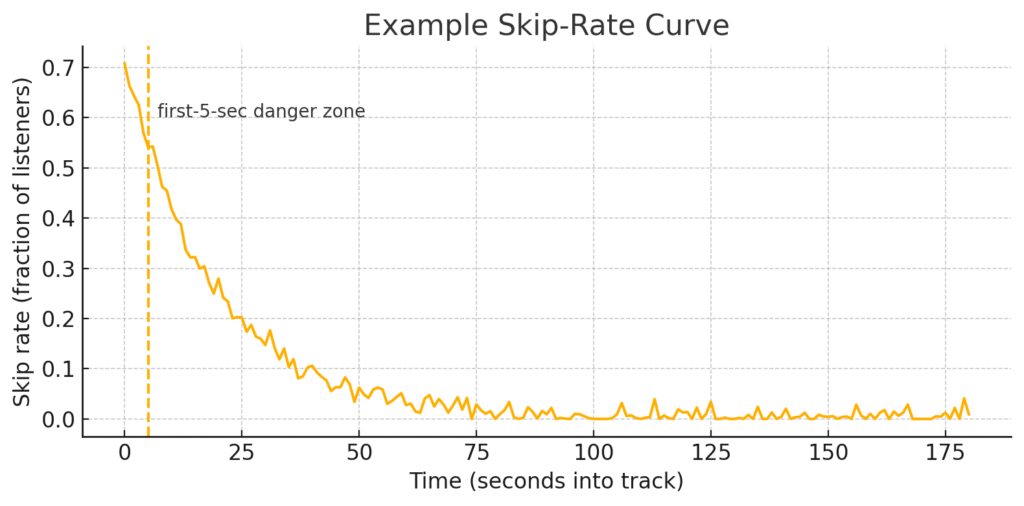
Look at the graph and ask three questions:
- How steep is the initial drop?
A vertical plunge means your intro is dead air—or worse, dated. - Where does the line flatten?
That’s your listener core. People who survive past this timestamp are feeling it. - Any weird spikes later on?
Sudden bumps at 1:10 or 2:45 point to sloppy transitions, off-key ad-libs, or that eight-bar bridge nobody asked for.
Why Fans Bail Before the Hook
– Slow intros – They heard a four-count, you gave them a 16-bar cinematic prelude.
– Genre fake-outs – If the cover art screams drill but the first hit is a soft pad, deuces.
– Over-compressed masters – Ear fatigue kicks in faster than you think.
– Samey playlist order – Shuffle two tracks in the same key/BPM back-to-back and the second feels like déjà-vu.
Hook Insurance: Surviving the First Five Seconds
Front-load the payoff. That one vocal ad-lib everyone quotes on TikTok? Bring a teaser of it into bar two.
Trim the fat. Nuke any elements that don’t reveal the song’s identity almost instantly.
Micro-earcandy. Risers, reverse cymbals, one-shot shouts—anything that pops in earbuds and buys you another ten seconds of attention.
Contrast cues. A half-beat pause, a surprise chord change, a filtered vocal. Disrupt autopilot scrolling.
Turning Data Into Green-Light Decisions
Track A: 25 % skip in first 30 s, flat after the hook → Video budget? Approved.
Track B: 48 % skip in first 15 s, spike at 1:20 → Fix the intro, maybe swap verse two for a feature.
Track C: 60 % bail before bar four → Thanks for playing; move on.
Pro teams run this analysis before spending a cent on TikTok ads, radio edits, or live-show set lists.
Build Your Own Feedback Lab
Numbers are cool, context is cooler. Drop your pre-release mix on a private TrackBloom link, let trusted ears leave time-stamped comments, then match that qualitative feedback to skip-rate curves once the track is live. You’ll know why fans dipped at 0:07 instead of guessing.
“Bridge feels empty @ 2:14” + skip spike at 2:15 = case closed.
Collect, tweak, re-upload, watch the curve flatten. That’s data-driven A&R—no major-label budget required.
Keep the Loop Spinning
Release ► Gather skips ► Patch weak spots ► Deluxe edition, remix, or killer live transition.
Every drop is a test. Treat skip-point science like your personal focus group and your batting average for “add to playlist” will climb faster than your ad spend ever could.
Ready to weaponise those 5-second stats? Centralise your feedback, fix the skips, and turn listeners into lifers with TrackBloom.
Now go make the next single impossible to skip.